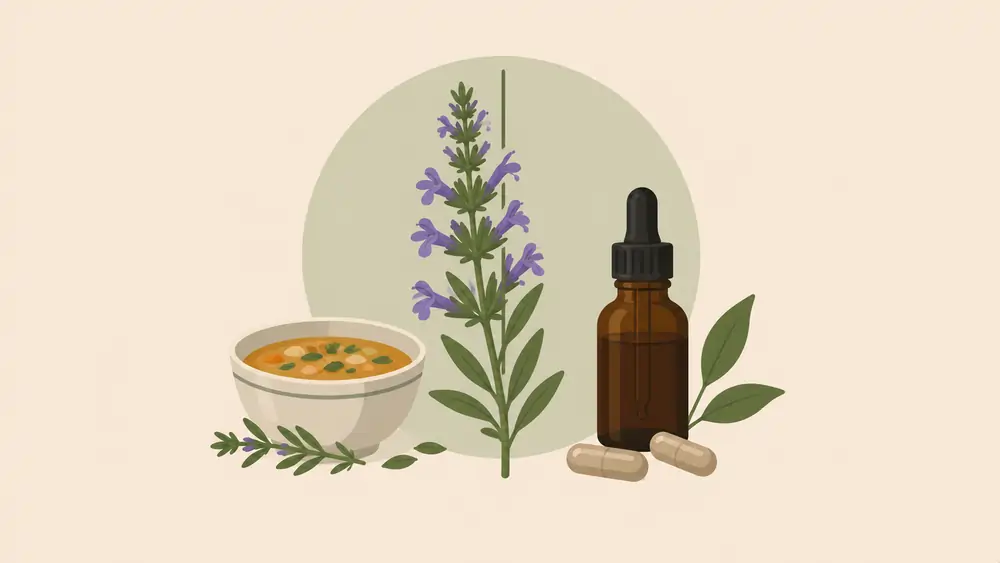
Hyssop in Cooking vs Hyssop Supplements is a practical question because the same herb name can appear in very different places: a recipe, a tea blend, a capsule, a tincture, an extract, or an essential oil. Seeing hyssop used as a culinary herb can make it feel casual, but a pinch in food is not the same as a concentrated supplement serving.
Hyssop, usually Hyssopus officinalis, has a long history as an aromatic herb. It can be used to flavor meats, soups, sauces, salads, sweets, and beverages. But context matters. A culinary sprinkle, a cup of herbal tea, a liquid extract, a capsule, and an essential oil are different product experiences. Secrets Of The Tribe treats this as serving-size literacy: the form changes how carefully a buyer should read the label.
This article does not provide medical advice. Hyssop products are not intended to diagnose, treat, cure, or prevent coughs, colds, digestive problems, respiratory conditions, infections, anxiety, or any disease. If you are pregnant or breastfeeding, under 18, taking medication, managing a health condition, sensitive to essential oils, or unsure whether hyssop is appropriate for you, ask a qualified healthcare professional before using hyssop supplements.
Is Hyssop in Food the Same as Hyssop in Supplements?
No. Hyssop in food and hyssop in supplements are different use contexts.
In cooking, hyssop usually appears in small amounts as a flavoring herb. In supplements, hyssop may appear as a capsule, tincture, concentrated extract, tea ingredient, or essential oil. These forms can differ in serving size, concentration, preparation, and intended use.
The herb name may be the same, but the exposure is not automatically the same.
Quick Comparison: Culinary Hyssop vs Supplement Hyssop
| Format | Typical Context | Main Buyer Question |
|---|---|---|
| Culinary herb | Small amount used for flavor | Is this a normal food-use amount? |
| Herbal tea | Steeped herb in water | How much herb is used and how often? |
| Capsule | Measured supplement serving | What is the serving size and plant part? |
| Tincture | Liquid extract in alcohol or glycerin base | What is the extract strength and suggested use? |
| Essential oil | Highly concentrated aromatic oil | Is it being used safely and appropriately? |
What Is Hyssop as a Culinary Herb?
Hyssop as a culinary herb is usually used for its strong aromatic flavor. It can taste herbal, minty, slightly bitter, resinous, and sharp. A little can go a long way.
In food, hyssop may appear in small amounts in stews, sauces, meat dishes, vegetable dishes, salads, sweets, liqueurs, and seasoning blends. This is a flavoring context.
Using hyssop as a seasoning does not mean every hyssop product should be treated like a kitchen herb.
Why Culinary Amounts Are Usually Smaller
Culinary herbs are often used in small amounts because their flavor is strong. A recipe may use a pinch, a few leaves, or a modest amount mixed with other ingredients.
Food also spreads the herb across a meal. That is different from taking a measured capsule, a dropper of tincture, or a concentrated extract by itself.
Serving size is the main difference. The question is not only “what herb is this?” but “how much and in what form?”
What Is Hyssop Tea?
Hyssop tea usually means dried hyssop herb steeped in hot water. It sits between food and supplement contexts. It may feel gentle because it is a tea, but it still involves a deliberate serving of herb.
The strength of the tea depends on the amount of herb, water volume, steeping time, cut size, freshness, and whether hyssop is blended with other herbs.
Do not assume every hyssop tea is the same. Read the label and follow the suggested preparation.
What Are Hyssop Capsules?
Hyssop capsules are dietary supplements. They may contain powdered herb, aerial parts, extract, or a blend. A capsule turns the herb into a measured supplement serving.
That serving may be more consistent than a culinary sprinkle, but it also requires more careful label reading. Check the Supplement Facts panel, serving size, plant part, amount per serving, and warnings.
Capsules should not be treated like a seasoning just because the source plant is culinary.
What Is Hyssop Tincture?
Hyssop tincture is a liquid extract. It usually uses alcohol, glycerin, water, or a combination as the extraction base. The liquid format can make the herb easy to measure, but it also changes the product experience.
A tincture may taste strong, bitter, herbal, sharp, or alcohol-like. The label should explain serving size, suggested use, extraction base, and whether the product is single-herb or blended.
Because tinctures are extracts, they should be compared by label details rather than by the fact that hyssop is also used in cooking.
Why Hyssop Essential Oil Is Not the Same as Dried Herb
Hyssop essential oil is highly concentrated aromatic oil. It is not the same as dried hyssop leaf, hyssop tea, or a culinary herb sprinkle.
Essential oils can contain concentrated volatile compounds. Hyssop essential oil is discussed in safety literature because certain chemotypes and constituents can raise concerns, especially around internal use and sensitive groups.
Do not use hyssop essential oil like a food herb or casual supplement. Essential oil safety requires specific expertise and product-specific guidance.
Format Comparison: What Changes With Concentration?
| Form | Concentration Level | Practical Meaning | Best Label Check |
|---|---|---|---|
| Fresh or dried culinary herb | Low to moderate in food context | Used mainly for flavor | Botanical identity and food-use amount |
| Tea | Depends on steeping and herb amount | Serving is more deliberate than seasoning | Preparation directions and blend ingredients |
| Capsule | Measured supplement serving | More structured than cooking use | Supplement Facts panel |
| Tincture | Extracted liquid form | Serving may be drops or droppers | Extraction base, serving size, herb ratio |
| Essential oil | Highly concentrated volatile oil | Not equivalent to dried herb | Safety guidance, intended use, professional advice |
Why Serving Size Matters More Than the Herb Name
The name “hyssop” tells you the ingredient category. It does not tell you the amount, strength, extraction method, plant part, or safety context.
Serving size helps define the product. In dietary supplements, the label should show the serving size and the amount of dietary ingredients. That makes capsules, tablets, tinctures, powders, and teas easier to compare.
If a product does not clearly show how much you are taking, be cautious.
Why Plant Part Matters
Hyssop products may use leaves, flowering tops, aerial parts, whole herb, or essential oil. These are not identical.
Aerial parts usually refer to the above-ground parts of the plant. Flowering tops may include the upper stems, leaves, and flowers. Essential oil refers to volatile aromatic oil, which is much more concentrated.
Read the label for plant part, not just the common name.
Why Botanical Name Matters
Common names can confuse buyers. “Hyssop” may refer to Hyssopus officinalis, but people also encounter anise hyssop, blue hyssop, giant hyssop, and other hyssop-like names.
Anise hyssop is usually Agastache foeniculum, not Hyssopus officinalis. That means a buyer looking for common hyssop should not rely on the word hyssop alone.
The botanical name is the cleaner confirmation.
Why Essential Oil Requires the Most Caution
Essential oil deserves the most caution because it concentrates aromatic compounds. A small bottle of essential oil does not represent the same exposure as a leaf in a stew or a mild tea blend.
Some essential oils are not appropriate for internal use. Hyssop essential oil is specifically discussed in safety contexts due to compounds that can be concerning, especially for people with seizure risk, pregnancy, breastfeeding, children, or sensitive health contexts.
Do not treat essential oil as a stronger version of tea. It is a different category.
Can You Cook With Hyssop and Also Take a Supplement?
That depends on the amount, format, frequency, your health context, and the exact product. A small amount in food is different from a regular supplement routine.
If you only use hyssop occasionally as a seasoning, that may not resemble a capsule or tincture serving. But if you drink hyssop tea, take capsules, use a tincture, and consume blends, your overall exposure may add up.
Keep a list of all herb formats you use. This helps avoid accidental overlap.
Why “Natural Flavoring” Does Not Mean Supplement Safety
Some herbs and essential oils can appear as flavoring agents in foods or beverages. That does not mean concentrated supplement use is automatically appropriate for everyone.
Food flavoring context, culinary context, dietary supplement context, and essential oil context are regulated and used differently.
Secrets Of The Tribe takes a cautious editorial stance here: the same plant name can appear across categories, but the category changes the safety conversation.
How to Read a Hyssop Supplement Label
Start with the Supplement Facts panel. Look for serving size, amount per serving, plant part, botanical name, extract ratio, alcohol or glycerin base for tinctures, and whether the product is single-herb or blended.
Then read the warnings. Look for pregnancy, breastfeeding, children, seizure history, medication use, surgery, chronic conditions, and essential oil cautions.
If the product uses vague language or only says “hyssop blend,” ask the seller for clarification.
How to Think About Hyssop in Tea Blends
Tea blends can make ingredient comparison harder because hyssop may be one herb among many. Other herbs may have their own taste, cautions, and serving considerations.
Check whether hyssop is the main ingredient or a minor flavoring herb. Check the full blend list, preparation directions, and suggested frequency.
Do not assume a tea blend is automatically casual because it is warm and familiar.
How to Think About Hyssop in Capsules
Capsules remove the taste but not the ingredient. That can make a strong herb feel easier to take, but it can also make people less aware of how much they are using.
Capsules should be treated as dietary supplements. Follow the label and avoid combining multiple hyssop products without checking the total routine.
If capsules include a proprietary blend, the exact amount of hyssop may be less clear.
How to Think About Hyssop in Tinctures
Tinctures make serving more flexible, but flexibility can lead to guessing. A dropper is not the same across all bottles. Dropper size, liquid viscosity, and label directions matter.
Check whether the tincture is alcohol-based or glycerin-based. Check the suggested serving and whether it is meant to be diluted.
Do not assume a tincture is equal to a cup of tea or a culinary herb amount.
Who Should Be Extra Careful With Hyssop Products?
Extra caution makes sense for pregnant or breastfeeding people, children, teens, people with seizure history, people taking medications, people with chronic health conditions, and anyone considering essential oil use.
People with allergies to mint-family plants should also be careful. Hyssop belongs to the Lamiaceae, or mint family.
When safety is unclear, ask a qualified healthcare professional before using supplement forms.
Hyssop in Cooking vs Hyssop Supplements Checklist
Use this checklist before comparing culinary hyssop, hyssop tea, capsules, tinctures, extracts, or essential oil. The goal is to understand the format before assuming all hyssop use is the same.
Confirm the Botanical Name
Look for Hyssopus officinalis if you want common hyssop. Do not rely on the common name alone.
Identify the Format
Decide whether you are dealing with a culinary herb, tea, capsule, tincture, extract, or essential oil.
Check the Serving Size
Food amounts, tea portions, capsule servings, and tincture droppers are not automatically equivalent.
Check the Plant Part
Look for leaf, flowering tops, aerial parts, whole herb, or essential oil.
Review Concentration
Extracts and essential oils are more concentrated than casual culinary use.
Scan for Blends
Tea blends, capsules, and tinctures may include other herbs that change the routine.
Respect Essential Oil Caution
Do not treat hyssop essential oil as a food herb, tea, or ordinary supplement.
Check Personal Risk Factors
Pregnancy, breastfeeding, seizure history, medication use, age, and chronic conditions should trigger professional review.
Avoid Doubling Up
If you cook with hyssop, drink hyssop tea, and take a supplement, review the total pattern rather than each use alone.
Common Mistakes to Avoid
Thinking Food Use Means Unlimited Supplement Use
A culinary herb amount is not the same as a concentrated capsule, tincture, extract, or essential oil.
Ignoring the Botanical Name
Hyssop-like names can refer to different plants. Check for Hyssopus officinalis.
Treating Essential Oil Like Tea
Essential oil is a concentrated aromatic product and needs a different safety mindset.
Skipping Serving Size
The serving size tells you what the product considers one use.
Combining Multiple Formats Without Tracking
Food, tea, capsules, tinctures, and blends can overlap in the same routine.
FAQ on Hyssop in Cooking vs Hyssop Supplements
Is hyssop used in cooking?
Yes. Hyssop can be used as an aromatic culinary herb in small amounts for flavoring foods and beverages.
Is hyssop in cooking the same as a supplement?
No. A culinary amount is not the same as a capsule, tincture, extract, tea serving, or essential oil.
Why does serving size matter with hyssop?
Serving size defines how much hyssop the product expects you to use at one time.
Is hyssop tea a food or supplement?
Hyssop tea sits between culinary and supplement contexts. The amount, frequency, and label directions matter.
Are hyssop capsules stronger than cooking with hyssop?
They are different formats. Capsules provide a measured supplement serving, while cooking usually uses smaller flavoring amounts.
Is hyssop tincture the same as hyssop tea?
No. A tincture is a liquid extract, while tea is an infusion in water.
Is hyssop essential oil the same as dried hyssop?
No. Essential oil is a highly concentrated aromatic oil and should not be treated like dried herb.
What should I check on a hyssop supplement label?
Check botanical name, plant part, serving size, format, extract type, warnings, and whether it is a blend.
Who should be cautious with hyssop products?
Pregnant or breastfeeding people, children, teens, people with seizure history, medication use, allergies, or chronic conditions should seek professional guidance.
Glossary
Hyssop
An aromatic herb usually referring to Hyssopus officinalis.
Hyssopus officinalis
The botanical name for common hyssop.
Culinary Herb
An herb used in food or beverages mainly for flavor.
Dietary Supplement
A product taken to supplement the diet, often sold as capsules, tablets, powders, tinctures, or extracts.
Serving Size
The amount the product label defines as one serving.
Tincture
A liquid extract made with alcohol, glycerin, water, or a combination.
Essential Oil
A concentrated aromatic oil extracted from plant material.
Aerial Parts
The above-ground parts of a plant, often including leaves, stems, and flowers.
Extract
A prepared ingredient made by extracting compounds from plant material.
Lamiaceae
The mint family, which includes hyssop, mint, basil, sage, oregano, and many other aromatic herbs.
Conclusion
Hyssop in Cooking vs Hyssop Supplements comes down to amount, format, concentration, and context. A culinary sprinkle is not the same as a capsule, tincture, extract, or essential oil, so read the label before treating all hyssop use as equal.
Sources
Hyssop overview and culinary uses for meats, fish, vegetables, salads, sweets, and liqueurs, Encyclopaedia Britannica — britannica.com/plant/hyssop
Hyssopus officinalis plant profile including cooking uses, flowers, foliage, and hyssop oil flavoring context, Missouri Botanical Garden — missouribotanicalgarden.org/PlantFinder/PlantFinderDetails.aspx?kempercode=b939
Hyssopus officinalis essential oil phytochemistry and common use in cosmetics, perfumes, beverages, and food additives, National Institutes of Health / PubMed Central — pmc.ncbi.nlm.nih.gov/articles/PMC8776447
Essential oils and seizure-related safety discussion including hyssop and other oils, National Institutes of Health / PubMed Central — pmc.ncbi.nlm.nih.gov/articles/PMC6556313
Dietary supplement label guidance for serving size and dietary ingredient quantity declaration, U.S. Food and Drug Administration — fda.gov/food/dietary-supplements-guidance-documents-regulatory-information/dietary-supplement-labeling-guide-chapter-iv-nutrition-labeling
Federal dietary supplement labeling rules for Supplement Facts and serving size, Electronic Code of Federal Regulations — ecfr.gov/current/title-21/chapter-I/subchapter-B/part-101/subpart-C/section-101.36
Dietary supplement consumer guidance and label-reading basics, U.S. Food and Drug Administration — fda.gov/food/information-consumers-using-dietary-supplements/questions-and-answers-dietary-supplements
Structure/function claims and required dietary supplement disclaimer language, U.S. Food and Drug Administration — fda.gov/food/nutrition-food-labeling-and-critical-foods/structurefunction-claims